Battery pack assembly: the equipment list
Battery modules require controlled joining processes and insulation matched to the cell design. Tape, ultrasonic welding and mechanical crimping are common options; select and validate each process against component temperature limits and the assembly drawing.
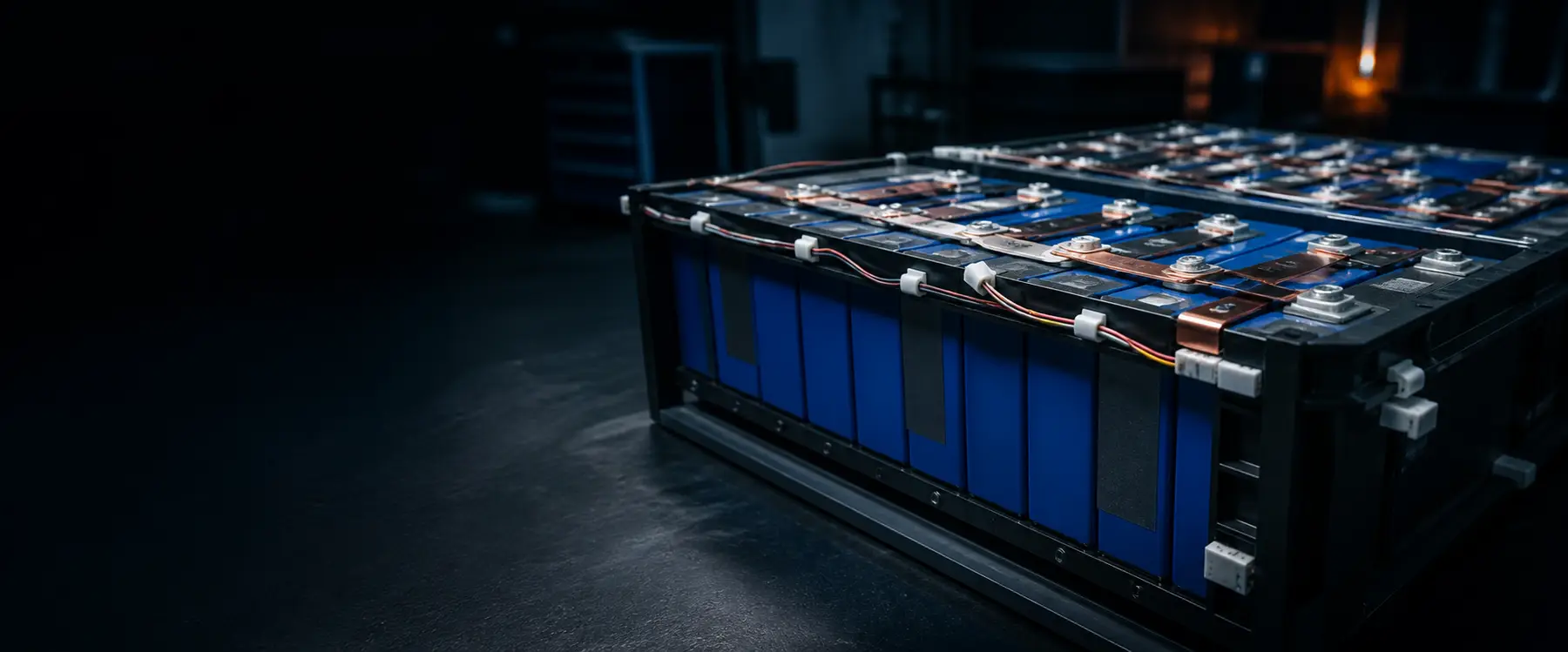
| Step | Equipment | Why it's needed |
|---|---|---|
| 1. Cell insulation | High-temperature cell taping machine | Tape applied to cell sides and faces at 1,500–1,800 pcs/h — insulation without heat |
| 2. Tab preparation | Handheld tab taping / tape wrapping | Cordless taping for tabs and touch-ups where a bench machine cannot reach |
| 3. Interconnect welding | Ultrasonic metal welder | Solder-free copper joints for tabs and busbars — validate joint quality, local temperature rise and effects on the cell |
| 4. Power cable termination | Hydraulic or servo lug crimping | Pack output cables run 25–120 mm²; lugs need 10–30 tons, not a 2-ton bench press |
| 5. Harness & sensing | Cut, strip and crimp machines | The low-voltage sensing loom — small gauge, many circuits, every one identified |
| 6. Testing | Insulation and continuity tester | Insulation resistance and point-to-point verification before the pack is closed |
Watch the machines on this line running real wire
Close-ups of the heads listed above, 10–30 seconds each, on wire like yours. If one answers your question, send 2–3 metres of your own and we run it on that head, on video, before you order.
More clips on these questions:Charging-gun and battery cable: can a machine do the end without heat? · Ultrasonic splice or crimp? · Taping: can a machine wrap a single wire, or only a bundle?
Why tape, and why ultrasonic
Both choices come from the same constraint: heat near a cell is a hazard, not an inconvenience. Heat-shrink processing introduces heat, so use it near cells only within validated component limits. High-temperature tape offers another insulation route: the WM-477 tapes cell sides and the WM-476 tapes both faces and the top of flat cells, each at 1,500–1,800 pcs/h, with a cordless handheld for tabs. The same logic drives the joining method: soldering puts a hot iron and molten metal against a tab, while ultrasonic welding joins compatible metals using vibration and pressure — no solder or flux added; the joint, local temperature rise and effect on the cell must still be validated. Size the welder by the total gathered cross-section: 0.75–20 mm² on the WM-711, up to 30 mm² on the WM-717S, and 50 mm² on the WM-718.
Battery assembly equipment — common questions
Why is battery cell insulation done with tape instead of heat shrink?
Because heat shrink needs heat. Applying a sleeve means a hot air stream or an infrared oven next to a charged cell — a hazard that pack assembly avoids by design. High-temperature tape gives the same insulation with no thermal input: the WM-477 tapes cell sides and the WM-476 covers both faces and the top of flat cells, both at 1,500–1,800 pcs/h.
Ultrasonic welding or soldering for tabs and busbars?
Ultrasonic welding joins the copper with vibration and pressure without solder or flux. Verify joint quality, local temperature rise and effects on the cell using the actual materials. Size the machine by the total gathered cross-section of the joint, not the largest single conductor: published ranges here are 0.75–20 mm² (WM-711), 0.7–30 mm² (WM-717S) and up to 50 mm² (WM-718).
What crimps the pack output cables?
Lugs on 25–120 mm² cable need hydraulic or servo force, not a bench press. The WM-3234 crimps at 10 tons for 1–70 mm² and 30 tons for 6–120 mm²; the WM-3240 makes servo-controlled hexagonal crimps on 10–120 mm²; the WM-3218 is a 13-ton hydraulic machine for lugs to 75 mm².
What testing does a pack assembly line need?
Insulation resistance between the power circuit and the enclosure, and point-to-point continuity on the sensing harness — both before the pack is closed, because access afterwards is the expensive part. The WM-814 covers 128 points with conduction from 0.1 to 50 Ω, insulation from 1 MΩ to 1 GΩ, and high-voltage withstand in one hookup.
What should an inquiry include?
Cell format and dimensions (that decides the taping machine), tab and busbar cross-sections (that sizes the welder), output cable size and lug type, the sensing harness gauge and circuit count, and modules per shift. Then courier cells or dummy cells and a length of your busbar — we tape and weld your parts on camera before you order.
Get a price in 12 hours
Tell us your wire and volume — a specialist (not a bot) replies with a full quotation.
✓ Request received
Your reference:
Our engineering and sales team will contact you with a quotation proposal within 12 hours from sales@wiromac.com.